
When People Become the Control - What the Future Workforce means for HSE
Page Published Date:
November 16, 2026

On Wednesday 4 November, The Safe Step and The Next Step partnered with MinterEllison to host The Future Workforce: What It Means for HR, HSE and Leadership in Sydney.
Kristy Edser from MinterEllison facilitated a panel of Jane Bourke, Senior Leader of HSE Transformation at Woolworths and a director of the Australian Institute of Health and Safety; Andrew Nolan, who helps organisations turn AI ambition into practical adoption; Cathy Doyle, CPO at NobleOak; and Stacey Edmonds, founder of Lively.
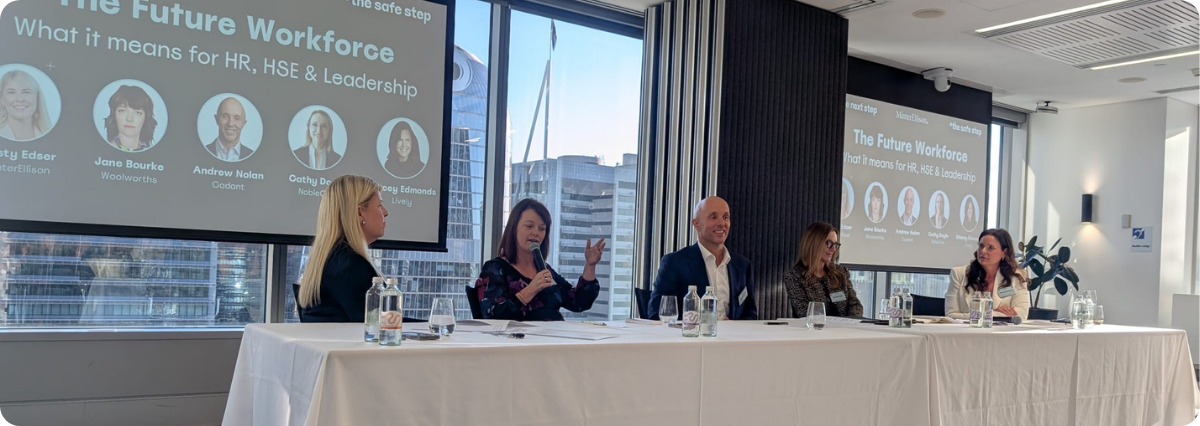
The discussion kept returning to safety. AI is changing how work is done, how risk shows up and who owns it.
Here are the key takeaways for HSE professionals.’
Key Takeaways for HSE
1. People are becoming the control, and controls degrade
Andrew Nolan described a shift across many roles. AI produces the work, and people check it. That makes human review a control in its own right.
"From a safety perspective, it's interesting, because humans are becoming the control. It's our job to check the work,
but the control degrades because we rely on it." Andrew Nolan
Andrew referenced a recent clinical study where practitioners' performance dropped after AI assistance was removed. The lesson for HSE is that skills fade when people stop doing the work. Any control that relies on human review needs a plan to keep those skills current.
2. Enable AI safely
Jane Bourke encouraged HSE professionals to lean in early and help shape how AI is adopted.
"Change is a constant in business today. As safety leaders, our goal shouldn't be to create friction or stifle innovation,
but to build the framework that allows the business to move forward safely. ." Jane Bourke
She gave an example from Woolworths, which has around 1,200 supermarkets across Australia.
Safety partners field the same routine questions again and again.
"Some of my safety partners get ten calls a day, probably with the same question." Jane Bourke
A well-designed AI assistant could coach people on those questions while knowing when to hand over to a safety partner. That frees HSE teams to move up the value chain and focus on higher-value work.
Jane also reframed the idea of checking AI output.
"I need to supervise them. I need to coach them. I need to guide them." Jane Bourke, on working with AI agents
3. Uncertainty is a psychosocial hazard
Cathy Doyle shared how a payment scam attempt affected staff in her organisation. The incident was stopped, but the stress lingered. Safety and HR spent the day helping people settle.
"It does lead to elevated cortisol and stress. I don't even know if I'm talking to an agent internally now or a human." Cathy Doyle
Her advice was to share these stories openly so people stay alert. Stacey Edmonds added that AI-enabled scams, including real-time deepfakes, are now easy to create.
"I think we underestimate the impact of being tricked or duped, and being in that position on a daily basis." Stacey Edmonds
4. Existing obligations already apply
Jane cautioned against rushed regulation with unintended consequences. She pointed out that HSE professionals already have a duty to consider the physical and psychosocial impact of the systems they introduce.
"We already have the obligation. We should already be thinking, for systems we have in place, what the consequences are for our team,
physically and mentally." Jane Bourke
Kristy Edser noted that changes to workplace surveillance, privacy and industrial relations laws have been widely discussed but are yet to land in most jurisdictions.
5. Monitoring tools carry psychosocial risk
Andrew described an organisation considering daily, AI-generated sentiment reports on every employee, built from emails, meetings and messages.
He questioned what managers would do with that information and how it would affect people.
Kristy raised the regulatory angle. Organisations are expected to act on what employee surveys tell them. The same expectation could apply to continuous monitoring data.
6. HR and HSE need to work as one
Kristy observed that HR and safety responsibilities increasingly overlap, with the convergence of Safety and IR legislation on psychological health and duty of care. Rather than getting caught in debates over where one remit ends and the other begins, higher-performing organisations recognise that functional ownership is the wrong focus entirely.
"It's neither one or the other. We've got to work together." Jane Bourke
Jane's anchor is the person affected. They want to be supported holistically, whichever function leads. She noted that HSE brings strength in risk and controls, while HR brings expertise in role design, leadership and culture.
Kristy observed that HR and safety responsibilities increasingly overlap, with the convergence of Safety and IR legislation on psychological health and duty of care. Rather than getting caught in debates over where one remit ends and the other begins, higher-performing organisations recognise that functional ownership is the wrong focus entirely. Jane said the early days involved a lot of back and forth over ownership.
"It's neither one or the other. We've got to work together." Jane Bourke
Jane's anchor is the person affected. They want to be supported holistically, whichever function leads. She noted that HSE brings strength in risk and controls, while HR brings expertise in role design, leadership and culture.
Cathy said psychosocial risk is now her organisation's biggest risk, and that related claims are rising.
"Two heads are better than one." Cathy Doyle
7. Leadership in uncertain times
The panel agreed that courage matters most right now. Leaders face pressure to move quickly on AI, and need to be willing to pause when something doesn't feel right.
"Knowing that you don't have the answers, and being okay with that.
It's about bringing the right skill sets together to work collectively on a path forward" Jane Bourke
What HSE can do now
- Treat human review of AI output as a control. Assess how it could degrade and how you will keep skills current.
- Get involved early in AI projects so safety is designed in from the start.
- Include AI-enabled scams, deepfakes and digital uncertainty in your psychosocial risk assessments.
- Apply your existing duties to every new digital system, including monitoring and sentiment tools.
- Build a working partnership with HR on psychosocial risk, work design and leadership capability.
Merridy Thomas closed the evening by noting that HR and safety are increasingly working as one, and that HSE professionals will help lead this transformation.
"Your network will be your most important thing for your future." Merridy Thomas