
The hidden cost of poor role design in Australian workplaces
Page Published Date:
June 18, 2026


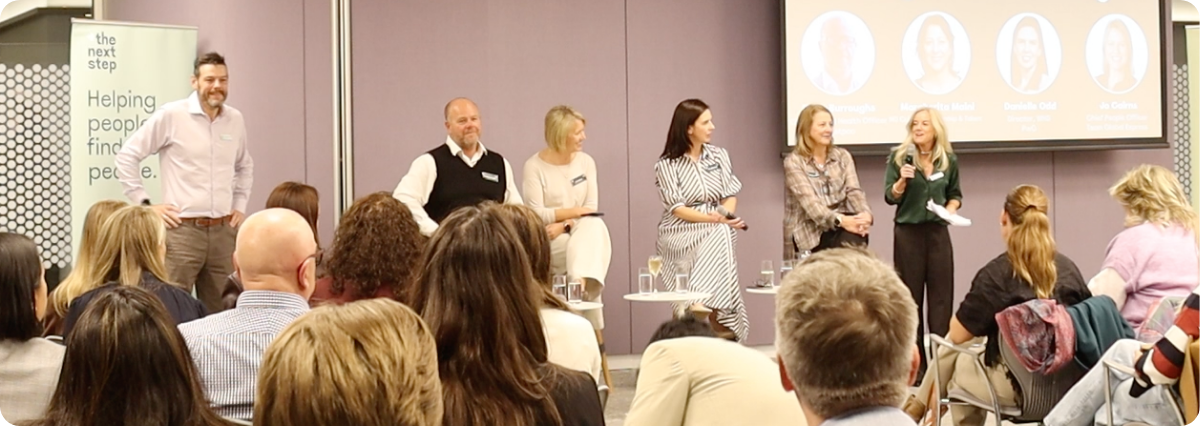
At a recent panel event hosted by The Safe Step and The Next Step at PwC's Barangaroo offices, Dave Burroughs, Principal Psychologist at Australian Psychology Services and Chief Mental Health Officer at Westpac, shared a case study to reframe how many leaders think about psychosocial risk
At an organisation he was consulting with, the leadership team of 300-plus people was overworked and fractious. The first instinct was to find more resources. His team took a different tack.
"We took a psychosocial job design approach. What we found was that work overload was associated with lack of role clarity,
and the lack of role clarity was associated with poorly managed organisational change."
When they applied a job design lens across the full leadership group, they found 1,800 hours of wasted work every week; what Dave calls "hindrance work." That's the equivalent of 45 full-time staff. They quantified the annual cost at $25 million.
Why does this matter now?
Serious psychological claims in Australia have increased by 161% over the past decade. Safe Work Australia's 2025 statistics show mental health conditions now account for 12% of all serious claims, with median time lost almost five times longer than for other injuries.
SafeWork NSW estimates workplace mental ill health costs Australian businesses up to $39 billion annually in lost participation and productivity, citing Deloitte Access Economics.
But those figures only capture what surfaces as a claim. Dave's case study points to a much larger cost: the productivity drain from poor job design that never registers in incident data.
When change is managed poorly, roles blur. When roles blur, people spend time navigating confusion rather than doing useful work. That wasted effort accumulates quietly, and the cost rarely gets attributed to its actual cause.
What are organisations getting wrong?
The typical response, as Dave noted at the event, is to add headcount or run a culture initiative.
"The usual response is: there's friction, let's go to the Barossa.
Or maybe we just recruit more people. We should always recruit more people."
Both responses are Band-Aid solutions that don’t address the cause. Under WHS regulations now in force across every Australian jurisdiction, employers are required to identify, assess, and control psychosocial hazards. Poor role design, and the confusion it generates, qualifies as one.
What does good practice look like?
At Team Global Express, Chief People Officer Jo Cairns described building a data model that mapped turnover, safety statistics, manager tenure and industrial activity across sites simultaneously.
"When you look at that data while you're doing your risk assessments and your consultation,
you can actually know where you need to have a closer look."
The approach Dave outlined added the job design layer: a structured analysis of what work is really happening, whether it matches the current roles, and where the gaps or overlaps are generating friction. Both approaches are practical, replicable and complementary.
The question worth asking
If you mapped ‘hindrance work’ across your leadership group this week — the meetings that achieve nothing, the duplicated effort, the decisions that get made twice — what would its cost be? Across a team of 100, even two wasted hours per person per week is 200 hours. At a senior salary, that number adds up quickly.
The Safe Step works with safety leaders and organisations navigating psychosocial risk, job design, and the intersection of the two. If this raises questions about your own organisation, get in touch.
Our partner firm, The Strategic Step Advisory, specialises in workforce solutions and organisational design. Contact them for a confidential conversation here.